Jupiter Power is proposing to build the Liberty Energy Storage Projects in Madison County, Indiana. The Liberty projects include two battery energy storage sites, which are expected to be operational between 2028 and 2030. Together, they will provide 380MW of electricity. The Liberty projects are not connected to or associated with any wind or solar farms.
The projects are a $500 million investment in Madison County infrastructure that is estimated to pay almost $73 million in property taxes over 25 years. Of that number, $32.5 million will go to South Madison schools and $12.4 million will go to Adams Township. These projects will be built on property next to Indiana Michigan Power’s Fall Creek Substation, which is the largest substation in Madison County and is at a critical juncture of the power grid, vital to the stability of both the local and regional grids.
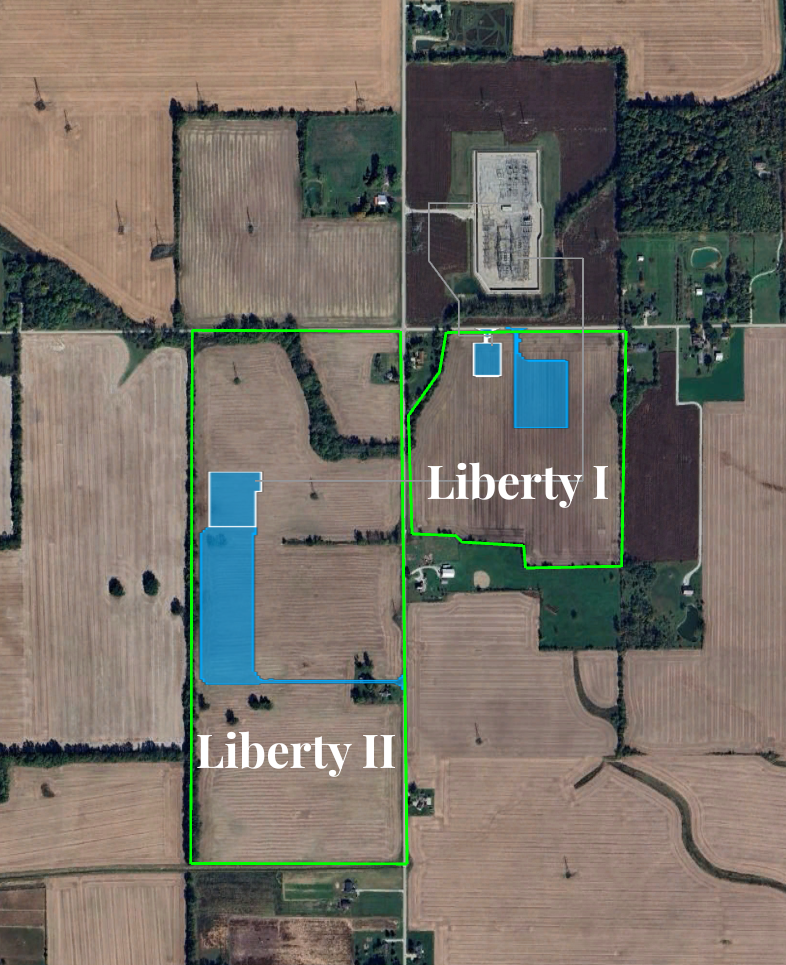
PHOTO ABOVE: THE PROPOSED LOCATION OF THE LIBERTY ENERGY STORAGE PROJECTS
Project Location
The Liberty projects will be located near the intersection of 800 South and 400 East Roads northeast of Markleville in Madison County. Each project will sit on a separate parcel of land adjacent to the existing Fall Creek substation, which is immediately across the road to the north of the projects.
The figure to the left shows a high-level outline of the projects. The green lines show the leased property; the blue shapes are the footprint of the battery infrastructure; the white-outlined portions show the project substations, and the grey lines are the power lines that connect the project to the substation. The additional leased property will continue to be farmed.
Since this battery is not directly connected to a renewable or other power source, it must connect directly to the substation to charge when energy demand is low, and flow back onto the grid during high demand, which can help keep costs lower and strengthen the reliability of the grid.
The figure to the left shows a high-level outline of the projects. The green lines show the leased property; the blue shapes are the footprint of the battery infrastructure; the white-outlined portions show the project substations, and the grey lines are the power lines that connect the project to the substation. The additional leased property will continue to be farmed.
Since this battery is not directly connected to a renewable or other power source, it must connect directly to the substation to charge when energy demand is low, and flow back onto the grid during high demand, which can help keep costs lower and strengthen the reliability of the grid.
Project Status
The projects are currently in the outreach and permitting phase. Jupiter has submitted permit applications for both projects, which are currently under review by Madison County.
Liberty I is anticipated to begin construction in 2027 and be operational in 2028. Indiana Michigan Power (I&M) has signed an agreement with Jupiter Power to purchase the Liberty I Storage Project upon its completion, pending local permitting and approval by the Indiana Utility Regulatory Commission (IURC).
Liberty II is on a longer development timeline, with operations anticipated by the end of 2030. As a result, long-term ownership of Liberty II has not yet been determined. Further updates to project schedules and status will be posted on this website.
Liberty I is anticipated to begin construction in 2027 and be operational in 2028. Indiana Michigan Power (I&M) has signed an agreement with Jupiter Power to purchase the Liberty I Storage Project upon its completion, pending local permitting and approval by the Indiana Utility Regulatory Commission (IURC).
Liberty II is on a longer development timeline, with operations anticipated by the end of 2030. As a result, long-term ownership of Liberty II has not yet been determined. Further updates to project schedules and status will be posted on this website.

Photo above: The projects are currently in the outreach and permitting phase.
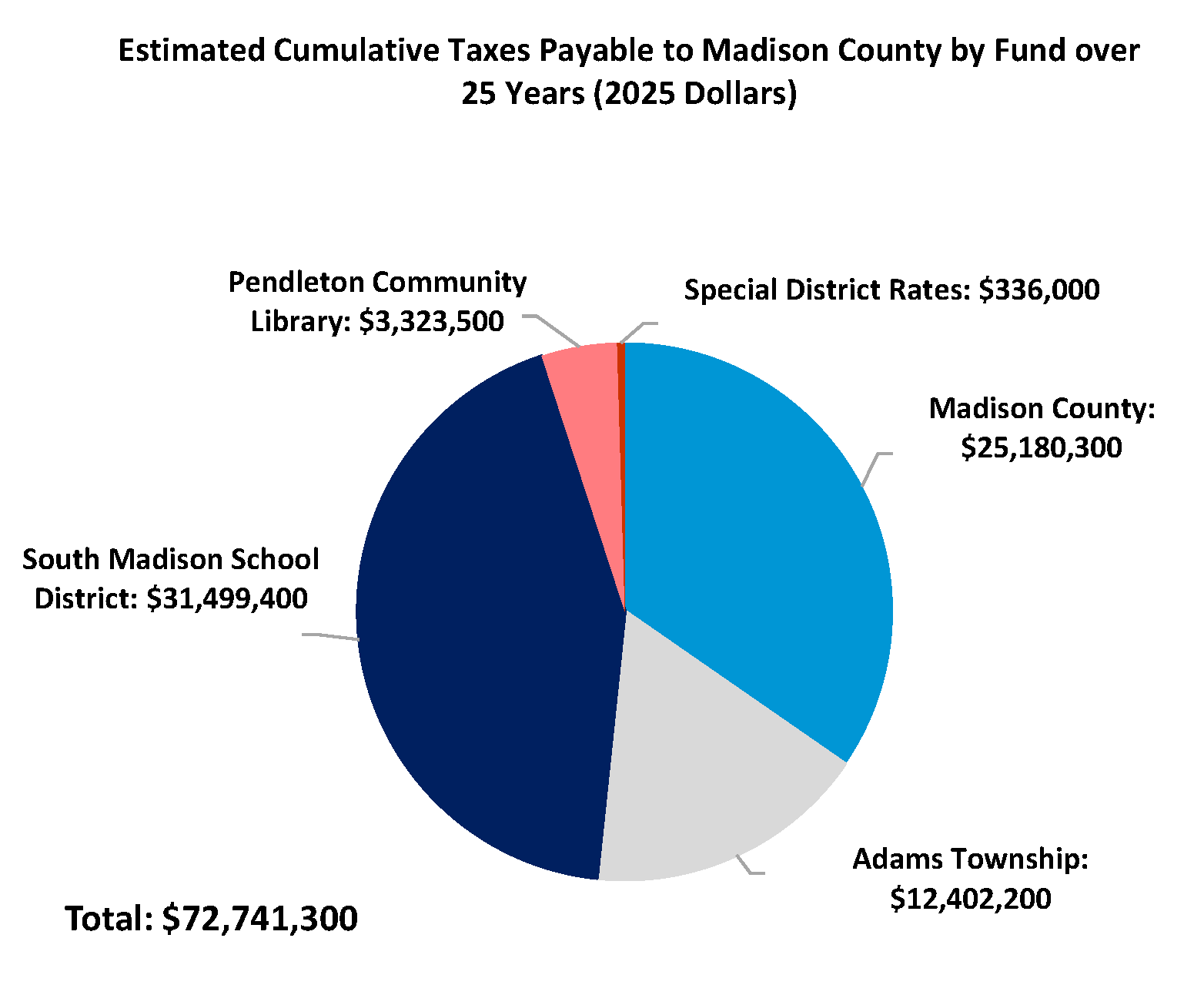
Photo above: bREAKDOWN OF LOCAL TAXES TO BE PAID
Community Benefits
The Liberty Energy Storage Projects will benefit residents and businesses by improving the power grid and supporting the local economy.
- The Liberty Projects are estimated to pay $72.7 million over the 25-year project life in property taxes. Here’s how that breaks down:
- $31,499,400 go to the South Madison School District
- $25,180,300 go to Madison County
- $12,402,200 go to Adams Township
- $3,323,500 go to the Pendleton Community Library
- $336,000 go to Special Districts
- This breakdown shows how tax revenue generated over the life of the project will go directly towards benefiting schools, Adams Township, and the wider community. More tax revenue paid by the Liberty projects also means less pressure to raise property taxes on homeowners.
- The projects will also generate jobs, approximately 250 construction jobs combined, and an estimated six full-time local technical positions for ongoing operations. Madison County residents are preferred and encouraged to apply for these positions.
- In addition to local tax revenue generated from the project, Jupiter plans to contribute to local organizations and opportunities once operational and welcomes suggestions on how we can go above and beyond to support local needs. Feel free to reach out via email at liberty@jupiterpower.io.
Project safety
At Jupiter Power, safety is our top priority—for the community and for our team—through every stage of the project. During normal operations, the Liberty facilities will not produce fumes, pollution, odor, dust, or other off-site impacts to those nearby.
Jupiter Power uses only standardized, lab-tested and approved equipment, complies with all National Fire Codes, including standards specifically governing energy storage, and specifically engineers our projects so that in the extremely unlikely case of an equipment malfunction, any resulting event can be managed safely. To make that possible during operations:
Jupiter Power uses only standardized, lab-tested and approved equipment, complies with all National Fire Codes, including standards specifically governing energy storage, and specifically engineers our projects so that in the extremely unlikely case of an equipment malfunction, any resulting event can be managed safely. To make that possible during operations:
- Each battery module is monitored 24/7 and is equipped with sensors, fire suppression systems and alarms.
- Every battery is individually tracked by advanced software to catch problems early.
- Enclosures are spaced deliberately to ensure that any potential fire would stay contained within a very limited area of the projects.
- The projects will be built to meet national Fire Code standards and will be tested to strict safety protocols developed by Underwriters Laboratories (UL), the world’s leading safety testing organization.
Jupiter has met with the South Madison Fire Territory and will work closely with them and other emergency responders throughout the process of the projects' design. Jupiter looks forward to continuing that coordination throughout the life of the projects, offering fire safety training opportunities and resources to support preparedness.
Bottom line: The Liberty facilities are designed with the highest safety standards, using cutting-edge technology, and with ongoing coordination with local first responders to ensure safe and responsible operations.
Bottom line: The Liberty facilities are designed with the highest safety standards, using cutting-edge technology, and with ongoing coordination with local first responders to ensure safe and responsible operations.

Photo above: jupiter power storage site facility in west texas
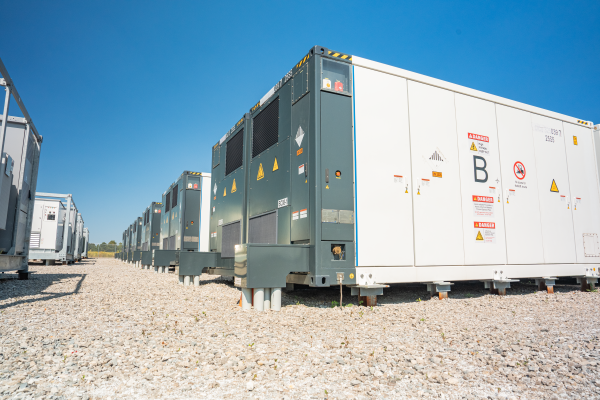
Photo above: jupiter power storage site facility in MICHIGAN.
Why Battery Energy Storage?
- Getting more from our existing grid By charging when there is more power available on the grid than needed to meet demand, and then shifting that supply to when it’s needed most, energy storage helps us get more out of the power grid we already have, potentially reducing the need for new power plants and power lines.
- Customer demand Homes and businesses need reliable energy at all times. Morning and evening hours are typically when the largest amount of energy is needed from the grid to serve customers. During these times, we can pull energy from batteries to meet the high demand when other sources of power would be more expensive or unavailable.
- Maintain stability Supply and demand of energy fluctuate throughout the day and sudden changes in either can affect grid stability. Batteries can act much faster than other power sources to help even out the fluctuation of energy on the grid, helping to ensure that our power supply remains stable.